On this page
Mostly, no — and that is measured, not opinion. The UK consumer organisation Which? has tracked Black Friday prices for years: about 8 in 10 deals checked for 2025 were the same price or cheaper at other times of year, and a 2020 sample put the figure at nearly nine in ten (both read 29 September 2026, in each case via the press reports of the research). That does not mean no deal is real. It means the label “Black Friday deal” is not itself evidence — and the check takes about ten seconds.
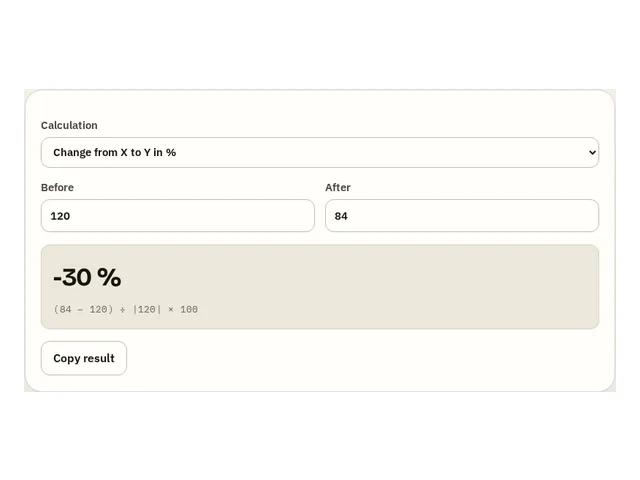
The calculator above is the full percentage tool from the tool page, running on this page. Pick the change direction, type the “was” price and the deal price, and it shows the honest percent off with the line of arithmetic underneath — nothing is uploaded, and it works on any shop’s numbers.
Is Black Friday actually cheaper?
For most deals, no. Which? reported in November 2025 that about eight in ten Black Friday deals it tracked were the same price or cheaper at other times of year. One retailer made it concrete: at Very, 93 % of Black Friday deals were the same price or cheaper outside the Black Friday period, and cheaper in 63 % of cases (Which? research, reported 25 November 2025). Five years earlier the picture was the same — nearly nine in ten Black Friday products were available at the same price or cheaper earlier in the year (Which?, 2020).
Two honest limits on those numbers. They describe whole ranges of offers across many shops, not the one kettle or coat in front of you: some deals genuinely are the cheapest of the year, and the research tells you the odds, not the verdict for your item. And they are another organisation’s findings, quoted with their date — this site’s contribution is the check you run yourself, which is the rest of this page.
Which categories actually get the biggest Black Friday discounts?
Two questions hide inside that one, and they need separating: how deep a category’s discounts run, and whether the day’s price is the year’s lowest. The first is measurable; the second is where the traps live.
How deep discounts ran in the 2025 US online season — measured by Adobe Analytics across a trillion visits to retail sites and 100 million products (published 7 January 2026, read 29 September 2026):
| Category | Peak discount off list price, 2025 season | 2024 season |
|---|---|---|
| Electronics | 30.9 % | 30.1 % |
| Toys | 29.6 % | 28 % |
| Apparel | 25.1 % | 23.2 % |
| Televisions | 24.3 % | 24.2 % |
| Computers | 23.4 % | 22.8 % |
| Sporting goods | 20.3 % | 19.5 % |
| Appliances | 20.2 % | 19.2 % |
| Furniture | 18.8 % | 19 % |
Adobe’s day-by-day reading of the same season (forecast, 6 October 2025): the deepest TV, toy and appliance discounts land on Black Friday itself; electronics, apparel and computers go deepest on Cyber Monday, the Monday after; sporting goods on Thanksgiving Day.
Now the counterweight, because depth is measured off the listed price — and a big percent off a list price is not the same as the year’s lowest price. When Which? tracked 175 home, tech and health appliances across eight UK retailers for a full year, May 2024 to May 2025 (published 25 November 2025, read 29 September 2026), not a single one was at its cheapest price of the year on Black Friday. Every product had been the same price or cheaper at another time. One worked example from that research: a Samsung robot vacuum cleaner at £350 on Black Friday had sold at £299 for 29 days the previous May and June.
The practical reading: electronics, toys and apparel are where percent-off runs deepest, so they are where checking pays the most — and the check stays the same ten-second one. The calculator above works the item in front of you; the price history answers whether the “was” price behind that percent was real.
How do I check if a deal is real?
Four steps, about three minutes, works on every deal:
- Work out the real percent off. The tag says “was $120, now $84”. That is (120 − 84) ÷ 120 = 30 % off — nowhere near half price, which would be $60. Percent-off is the one number shops cannot inflate, because you can check it: the calculator above shows the line.
- Look up the price history. Before the arithmetic impresses you, find out what the item actually cost in September. Price-history trackers are the tool for this — the next section names the established ones.
- Compare per unit, not per sticker. A “deal” on the big pack is only a deal per gram, per sheet or per litre. The table further down works an example where 30 % off the small pack beats the big pack’s everyday price.
- Read the “was” price with the history in hand. A discount is measured against something. If that something was a two-week price nobody paid, the percent is technically true and practically meaningless.
One more piece of arithmetic worth knowing: a coupon stacked on a deal price multiplies, it does not add. An extra 20 % code on the $84 deal lands at 84 × 0.8 = $67.20 — that is 44 % off the original $120, not the 30 + 20 = 50 % the stickers imply.
What was the price before Black Friday?
Price-history sites answer this directly. camelcamelcamel and Keepa chart Amazon prices going back years — type the product name and read the line. PriceSpy and idealo do the same across many shops, not just one. None of these are ours and none pay us; they are simply where the history lives. (This site tracks no prices itself and quotes none.)
The question you are asking in that chart is simple: did the item actually sell at the “was” price, and for how long? An honest “was” price was the real, current price for a reasonable stretch before the sale. The trick version — and it is the oldest one in the book — is a higher price that existed for a few days only, or an “original” that belongs to a different pack size. The history makes the difference visible at a glance.
When no history exists, because the shop is small or the product is new, today’s price at two or three other sellers is a working reference. If the deal beats all of them, it is a real deal.
How do I compare deals per unit?
Divide the price by the amount, then compare the results. Two packs of the same coffee (worked example, not a shelf price):
| Pack | Price | Per 100 g |
|---|---|---|
| 500 g | $6.00 | $1.20 |
| 750 g, “deal” | $8.25 | $1.10 |
The big pack wins — until a “30 % off” sticker lands on the small one: $6.00 becomes $4.20, which is $0.84 per 100 g, and the comparison flips back. That is the whole skill: never compare stickers, always compare the same unit — and the pack checker, the second calculator at the top of this page, works your own numbers, ounces included.
When the two packs measure in different units — ounces on one, grams on the other — put them on one scale first with the unit converter. It shows the rate it used (one ounce is about 28.35 grams), so the division stays checkable by hand.
When is Black Friday 2026?
Friday 27 November 2026, the day after Thanksgiving (Thursday 26 November). The weekend shape is seller-side knowledge, not a promise: Etsy’s own seller guidance tells shops to run deals the entire Black Friday weekend (read 22 September 2026), and offers that start days early are normal. That is exactly why the checking habit matters more than the calendar.
The rest of the math lives on the Black Friday page: how stacked discounts really combine, what “buy one get one half price” is worth, and when a fixed amount off beats a percentage. Use all of it on everyone’s numbers, including ours.
Questions
Is Black Friday actually cheaper?
For most deals, no. Which? found about 8 in 10 Black Friday deals were the same price or cheaper at other times of year (2025 research, read 29 September 2026); a 2020 sample put it at nearly nine in ten.
Which categories have the best Black Friday deals?
By discount depth, electronics, toys and apparel lead: peaks of 30.9 %, 29.6 % and 25.1 % off list price in the 2025 US online season (Adobe Analytics, published 7 January 2026). Depth off a list price is not the year's lowest price, so the item's own price history is still the real check.
How do I check if a Black Friday deal is real?
Three moves: work out the real percent off, look the item's price history up, and compare the price per unit across package sizes. Each step takes about a minute and needs nothing but a calculator — the two calculators at the top of this page run the first and third moves on your own numbers.
What was the price before Black Friday?
Price-history sites show it: camelcamelcamel and Keepa chart Amazon prices over years, and PriceSpy or idealo track many shops. A 'was' price the item barely ever sold at is the oldest trick in the sale.
How do I work out the real discount?
Divide the difference by the old price: a deal price of 84 against a 'was' price of 120 is (120 - 84) / 120 = 30 % off. The calculator above does it in its change direction and shows the line of arithmetic.
When do Black Friday deals start and end?
Black Friday 2026 is Friday 27 November, and many sellers run offers across the whole weekend — Etsy's own seller guidance tells shops to do exactly that (read 22 September 2026). Deals that appear days early are normal, which is why the checking skill matters more than the calendar.
Does this page make money from any deal I check?
No. There are no deal listings, no paying shop links and no third-party prices here — the calculator runs in the browser, and every number in an example is labelled worked arithmetic.