On this page
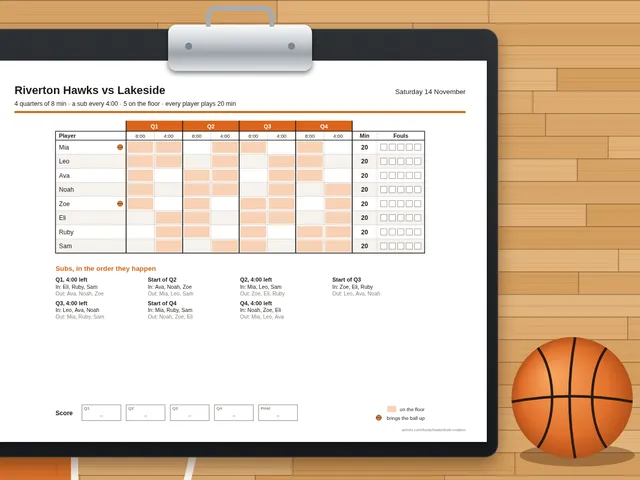
Fair playing time is the promise most youth leagues make, and it is the hardest thing to keep track of from the bench while the game runs. The arithmetic is simple: share the game’s player minutes evenly. Four 8-minute quarters with 5 on the floor are 160 player minutes, so 8 players get 20 minutes each and 10 players 16. Sub at the halfway mark of each quarter and send the bench in by turns, so every child plays the same number of stints, or one more. The maker above works the rotation out for your names and prints it for the clipboard.
The minutes, worked out
These are the rotation maker’s own results with 5 on the floor, sending in the next five players in the order at every sub. Where the minutes do not share evenly, the first players in the order play one stint more.
Four quarters of 8 minutes, with a sub at the halfway mark or every 2 minutes:
| Players | Sub every 4:00 | Sub every 2:00 |
|---|---|---|
| 6 | 4 play 28 min, 2 play 24 | 2 play 28 min, 4 play 26 |
| 7 | 5 play 24 min, 2 play 20 | 3 play 24 min, 4 play 22 |
| 8 | all 20 min | all 20 min |
| 9 | 4 play 20 min, 5 play 16 | 8 play 18 min, 1 plays 16 |
| 10 | all 16 min | all 16 min |
| 11 | 7 play 16 min, 4 play 12 | 3 play 16 min, 8 play 14 |
| 12 | 4 play 16 min, 8 play 12 | 8 play 14 min, 4 play 12 |
Shorter quarters for the youngest, and two halves of 20 minutes:
| Players | 4 × 6 min, sub every 3:00 | 2 × 20 min, sub every 5:00 |
|---|---|---|
| 6 | 4 play 21 min, 2 play 18 | 4 play 35 min, 2 play 30 |
| 7 | 5 play 18 min, 2 play 15 | 5 play 30 min, 2 play 25 |
| 8 | all 15 min | all 25 min |
| 9 | 4 play 15 min, 5 play 12 | 4 play 25 min, 5 play 20 |
| 10 | all 12 min | all 20 min |
| 11 | 7 play 12 min, 4 play 9 | 7 play 20 min, 4 play 15 |
| 12 | 4 play 12 min, 8 play 9 | 4 play 20 min, 8 play 15 |
Two things stand out. With 8 or 10 players every format shares exactly. And shorter stints bring an odd roster closer to even: with 9 players and a sub every 2 minutes, eight children play 18 minutes and one plays 16, against a 4-minute gap with subs every 4.
The rotation, step by step
- Put the squad in an order. The first five start. If a child should start, put them near the top.
- At every sub, send in the next five. Count on from where the last group ended and go round to the top of the list again. The players coming off are the ones whose turn is over.
- Keep the order all game. Every child then plays the same number of stints, or one more, and with up to 10 players everyone on the bench goes back in at the next sub.
- Change the starting point next game. Start the list with a different child and the extra stints go to someone else.
A ball handler on every group
A group of five with nobody who can bring the ball up is a long two minutes. Spread those players round the order so that never more than four others come between two of them: then every group of five that goes on has one. With up to 10 players two are enough, with 11 to 15 three. Tap them in the maker and it spreads them for you, says the new order, and names any stint that would still have none.
On the clipboard
The sheet prints landscape on US Letter or A4: the grid of who plays when, a ball beside each ball handler’s name, every sub in the order it happens with who comes in and who goes out, each child’s minutes, five foul boxes per player and the score after every period. A parent helper can call the subs from it, and nobody has to add up minutes from the bench. For the end of the season, the trading card maker prints a card for every player on the team.
Questions
How many minutes should each player get in youth basketball?
Divide the player minutes by the roster: the game's length times 5. In a 32-minute game that is 160: 20 minutes each with 8 players, 16 with 10, about 13 with 12. Some leagues set a minimum, such as a number of quarters for each child; your league's rules come first.
How do I sub fairly with 9 players?
Send in the next five each time, round the roster in order. At four 8-minute quarters with a sub every 4 minutes, four children play 20 minutes and five play 16; with a sub every 2 minutes, eight play 18 and one plays 16. Start the order with a different child each game and the extra minutes move round the team.
Should I sub every quarter or halfway through?
Halfway through, if your league allows it. With subs only between quarters, a child who sits out a quarter waits 8 minutes plus the break. A sub at the halfway mark halves the wait and spreads the minutes more evenly, and shorter stints even out an odd roster.
How do I keep a point guard on the floor?
Spread the players who can bring the ball up round the rotation, so that never more than four others come between two of them in the order. Then every group of five that goes on has one. Two are enough with up to 10 players, three with 11 to 15. The rotation maker spreads them for you and names any stint that would have none.
What goes on a youth basketball rotation sheet?
Who is on the floor in each stint, every sub in the order it happens (who comes in, who goes out), each child's minutes, and room for fouls and the score. The maker at the top of this page prints exactly that on one landscape page.