On this page
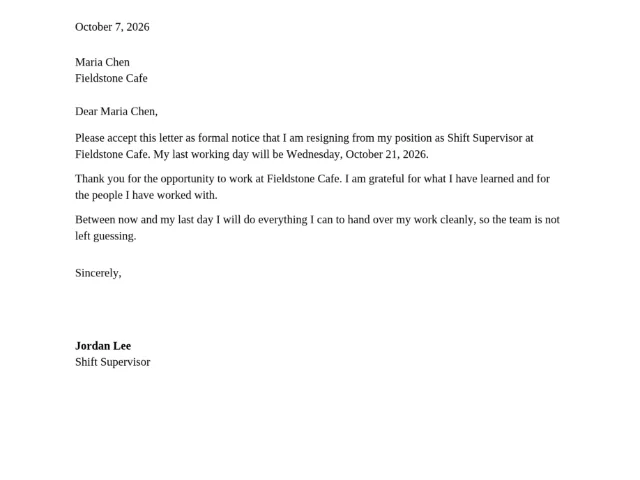
You write a two weeks notice by saying one thing plainly — that you are resigning and when your last working day is — and by leaving everything else out. The letter is four sentences of information and a signature, not an essay, and the maker running on this page builds it from your details: type your name, your manager, your position and your notice date, and the finished letter assembles itself, last working day computed, ready to print or copy into an email.
Every template on a search results page stops at [Date] and [Last Day] — placeholders you retype, and a date you have to count out yourself. This page finishes the job instead: the words, the date math, the paper.
What goes in a two weeks notice letter?
Four things, in this order. That is the whole letter:
| Part | What it looks like | Why it is there |
|---|---|---|
| The resignation, said plainly | “Please accept this letter as formal notice that I am resigning from my position as shift supervisor.” | The letter has one job. Do it in the first sentence, with no preamble |
| Your last working day | A full date: “My last working day will be Wednesday, October 21, 2026.” | The one date HR, payroll and your team all need. “In two weeks” without a date invites a dispute |
| A brief thank-you | One or two honest sentences about what the job gave you | It costs nothing, reads well in the file, and stays true even at a job you are glad to leave |
| The handover offer | “I will do everything I can to hand over my work cleanly.” | It tells your manager the next two weeks are calm, not a countdown to chaos |
What stays out matters just as much: complaints, detailed reasons for leaving, and the name of your next employer. None of them help you, and all of them live forever in an HR file. If you are leaving a job you hated, the letter still stays neutral — neutrality is what protects the reference call that comes a year later. The maker’s situation presets (standard, retail shifts, remote, short time at the job, going to a competitor) change only the middle paragraph; none of them asks where you are going.
Length follows from the four parts: three short paragraphs. One resume-tool vendor’s review of 4,200 real resignation letters found a median of 142 words (resumeoptimizerpro.com, updated September 8, 2026) — roughly the letter the maker above builds.
Is two weeks 10 business days or 14 calendar days?
Both readings exist, and employers mean both. The literal reading is 14 calendar days from your notice date. The working reading is 10 business days — two working weeks, counting the first working day of your notice as day 1 and skipping weekends. The tool above computes both for any date you type, so the letter carries a real date instead of a guess.
Two worked examples, computed by the tool (October 2026 calendar):
| Notice given | 14 calendar days | 10 business days |
|---|---|---|
| Wednesday, October 7 | Wednesday, October 21 | Tuesday, October 20 |
| Sunday, October 11 | Friday, October 23 — October 25 is a Sunday, so the letter moves it to the Friday before | Friday, October 23 (counting starts Monday, October 12) |
Most of the time the two land within a day of each other, and you pick which goes in the letter. Three honest limits the tool states on the page, repeated here: public holidays are not known to it (they vary by state and country, so a holiday inside your two weeks can pull the true last day earlier), a weekend landing moves to the Friday before because that is when you would actually work, and the one source that beats both readings is your own contract — if it states a notice period, that number counts.
One counting subtlety worth knowing: in the UK, a notice period usually runs from the start of the day after you hand it in (gov.uk, accessed September 30, 2026). The tool counts the notice day itself as day 1 of the business reading, the way US employers usually read it — another reason to state the finished date in the letter rather than the formula.
Do you have to give two weeks notice?
In the United States, almost never by law. Employment is presumed at-will in 49 states — either side can end the relationship at any time — with Montana the one exception (Cornell LII, accessed September 30, 2026). Two weeks notice there is a professional custom, not a legal duty. What can make it mandatory is paper: an employment contract, a union agreement, or an offer letter that states a notice period. Check yours before you write anything; if it names a number, that number is the one that counts.
In the United Kingdom the law sets a floor instead: you must give at least one week of notice once you have been employed for more than a month, and your contract can ask for longer (gov.uk, accessed September 30, 2026). Elsewhere notice periods are often set by law and scale with how long you have worked — the rule genuinely varies by country, so treat this paragraph as a starting point, not a map.
So why give notice at all in the US, where nobody forces you? Because the custom buys things the law does not: a manager who can speak well of you, a file that marks you eligible for rehire, and a handover you controlled instead of one that happened after you were walked out. Skipping notice is legal; it just spends those things.
This is general information, not legal advice — for a real dispute over notice or final pay, talk to a lawyer or your local labor agency.
What do you say when giving two weeks notice in person?
The letter is the record, but the conversation comes first. Two sentences are enough:
“I’ve decided to move on, and I’m giving my two weeks notice. My last day will be [date].”
Then stop talking. Your manager needs a moment, and the silence is theirs to fill. Expect three questions: why (a short, warm answer is fine — “an opportunity that fits where I’m heading”), where (you can keep it private — “I’d rather not say yet” is a complete sentence), and can you stay longer or leave sooner (that is a negotiation you can think about; the letter’s date is what you have offered).
Two rules of order make the whole thing go smoothly: your manager hears it before your colleagues do, and the letter follows the conversation the same day — handed over on paper, or sent as the email version the maker writes for you, with a subject line already in it.
Should you print the letter or send an email?
Both are normal, and the maker above builds the same letter either way. What differs is the record:
| Way | What it is good for | Watch out for |
|---|---|---|
| Printed letter, signed in ink | The classic. A paper document you sign, your manager keeps, and HR files. Fits formal workplaces | Hand it to your manager personally, and print a copy for yourself |
| Normal at remote and informal workplaces. It timestamps itself, and you can send HR a copy by adding one CC address | Keep the subject line plain — “Two Weeks’ Notice — [Your Name]” — so it is findable in a year | |
| Verbal only | The conversation that must come first | Not a record. Always follow it with the letter or email the same day |
Handwritten is valid too: dated, plain about the resignation, with the last working day stated. Typing simply gives HR a clean copy — and the printed version still gets your real signature in the ink space the maker leaves under the closing.
What happens after you hand in the notice?
The letter starts the last two weeks; the work in them is what your manager actually remembers. Three things finish the leaving-a-job job:
- Keep your own record of the final period. Hours have a way of getting lost in a handover. The printable timesheet calculator takes each day’s times — lunch breaks, overnight shifts — and prints a card with totals in hours-and-minutes and decimal, and signature lines for you and your supervisor. The card both of you sign is the card payroll cannot misread.
- Hand over like you promised in paragraph three. Files in order, passwords where your team can find them, a week of training whoever takes over. The letter offered it; the last two weeks deliver it.
- If the next step is working for yourself, the hours you just learned to track become invoices: the invoice generator turns line items into a clean PDF you can send, with nothing uploaded anywhere.
That is the whole job: a plain letter with a real date, a calm two weeks, and a paper trail you can check. The maker above has the letter part — you bring the rest.
All three tools — the letter maker, the time card and the invoice — collect on the work & career page, with the same rules: free, no sign-up, nothing uploaded.
Questions
Is two weeks notice legally required?
In the US, generally no — employment is presumed at-will (either side can end the job at any time) in 49 states, so notice is custom, not law, and only your own contract or offer letter can make it mandatory (Cornell LII, accessed September 30, 2026). In the UK the minimum set by law is one week of notice after a month of employment, and your contract can ask for more (gov.uk, accessed September 30, 2026).
Can my employer deny my two weeks notice?
An employer can end your employment earlier than the last day you offered — at-will employment cuts both ways. That does not make giving notice a mistake: the letter is a courtesy and a record, and how you leave is what your last manager remembers.
Is it better to quit on a Friday or a Monday?
There is no rule — pick a day your manager has ten quiet minutes, tell them before anyone else, and follow with the letter the same day. Many people choose late in the week so the news settles over a weekend, but the order matters more than the day.
Can I handwrite a two weeks notice?
Yes. A handwritten letter is a valid resignation notice as long as it is dated, says plainly that you are resigning, and states your last working day. Typing it just gives HR a clean copy for the file — the maker above prints one at true paper size with room to sign in ink.
How long should a two weeks notice letter be?
Three short paragraphs is normal. One resume-tool vendor's review of 4,200 real resignation letters found a median length of 142 words (resumeoptimizerpro.com, updated September 8, 2026) — about the length of the letter the maker above builds.
Do I have to say where I'm going next?
No. A resignation letter never needs the name of your next employer. If you are leaving for a competitor and want to be straightforward, "I have accepted a position with another company" says everything a letter needs to.