On this page
- What are good New Year resolutions for each age?
- How do you write resolutions with a child who can’t write yet?
- What makes a child’s resolution stick?
- Which year prints on the sheet — and when should you make it?
- How do you look back at the year first?
- What happens to the sheet after New Year’s Eve?
- Questions
The job is a happy one: an evening, a table full of children, and one question — what do you want from next year? The maker above is the live resolution sheet generator: type your child’s name, pick their age band, and print one page with the name and the right year already on it. It runs on this page, in your browser, and nothing you type leaves your device.
What the sheet does not answer — and what the idea lists elsewhere never do — is the part around the paper: which resolutions suit which age, how you get through the quarter-hour with a child who cannot write yet, and what keeps a child’s goal alive after the fireworks. That is this page.
What are good New Year resolutions for each age?
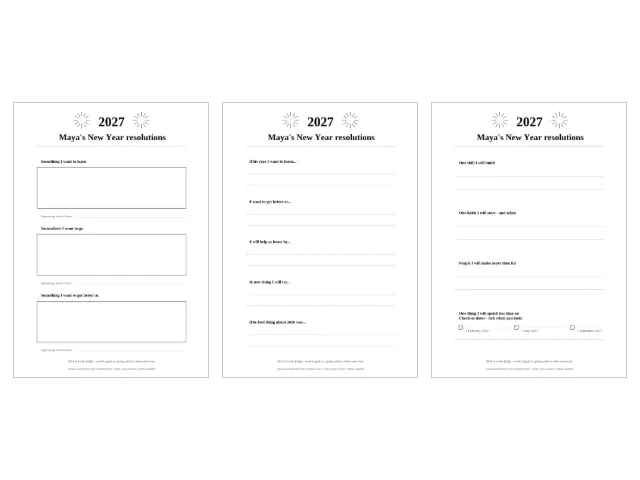
The honest answer is that the age decides the shape of the goal, not just the wording. A four-year-old cannot commit to “read twenty minutes daily”; a fourteen-year-old will not fill in a page of boxes meant for someone half their age. The sheet prints three different pages for exactly that reason, and the resolutions below are the ones that fit each page:
| Age | The sheet asks | Resolutions that fit, in a child’s words |
|---|---|---|
| 4–6 · draw | Something I want to learn, somewhere I want to go, something I want to get better at — drawn in three big boxes | “Riding my bike without stabilizers”, “the seaside”, “doing my own zip” |
| 7–12 · write | Five prompted lines: This year I want to learn…, I want to get better at…, I will help at home by…, A new thing I will try…, The best thing about last year was… | “Tying my shoelaces”, “swimming a whole length”, “emptying the dishwasher”, “a sleepover at Grandma’s”, “our holiday in the van” |
| 13+ · teen card | One skill I will build, one habit I will start — and when, people I will make more time for, one thing I will spend less time on | “Pass the piano grade 2 exam”, “go running on Sundays from January”, “actually call my cousin”, “my phone, after ten at night” |
Notice what the prompts do: they are already resolutions, half-made. A child staring at a blank line writes nothing; a child asked “I will help at home by…” usually has an answer before the pencil is ready. The printable sites that print empty lines — and the Etsy PDFs that charge for them — leave the hard half of the job to an eight-year-old.
How do you write resolutions with a child who can’t write yet?
You don’t write them — the child draws, you caption. The 4–6 sheet is built exactly for this, and the quarter-hour runs like this:
- Print the sheet with the child’s name on it and put out crayons, not pencils.
- Ask the three questions on the page out loud — something to learn, somewhere to go, something to get better at — and let the child draw the answers. A dog, a beach, a zip on a jacket.
- Write one caption line under each drawing, in the child’s words: “walk the dog”, “the seaside”, “do my own zip”. The drawing is the memory; your caption is the resolution.
The caption line under each box is on the sheet precisely so a grown-up’s handwriting can sit beside a child’s drawing. Ask “what is this?” rather than guessing — the caption is theirs even though the pen is yours.
What makes a child’s resolution stick?
Four things, all of them in how the evening is run rather than in the sheet:
One, not five. The sheet has room for several answers, but the resolution is the one the child cares about most. Ask them to point at their favourite before bedtime; that one becomes “the” resolution, the rest are conversation.
Theirs, not yours. “Tidying my room” typed by a parent is a chore list. The same room tidied because the child wrote it on their own sheet, with their own name printed at the top, is a different object — it is theirs, and they know it.
Small and on a day. “Get better at swimming” fades; “swim a whole length before Easter” has a finish line. The teen card asks for the day on purpose — one habit I will start — and when — because a goal with a start date is a plan, and one without is a mood.
Looked at again. This is the part the printable can actually deliver: the teen card prints three check-in dates — 1 February, 1 May and 1 September, computed for the year on the sheet. The check-in is one minute: find the sheet, read it again, see how it is going. No reward chart, no grader; the sheet comes out of the drawer, not onto a scoreboard.
And one honest limit, the same one the tool page states: a printable starts the ritual, it does not track a habit. If you want daily tracking, that is an app-shaped job and there are strong apps for it. What paper does — one evening, one page, three look-backs across the year — no app does better.
Which year prints on the sheet — and when should you make it?
The year is computed when you press the button, never fixed in a template. From late September the sheet targets the New Year being planned for — one made today prints 2027 — and earlier in the year it prints the year under way, so a January sheet is still for the fresh year. If you are the organized sort making sheets in November, or the honest sort making them on 3 January, the year selector moves one step either side.
The dates for this season, so you can plan the evening: New Year’s Eve is Thursday 31 December 2026, and the new year begins Friday 1 January 2027 — calendar arithmetic, not a guess. The classic window for the sheet is the quiet patch between the meal and the fireworks, but any evening in the first weeks of January works just as well, and classrooms run resolution worksheets when the term starts.
How do you look back at the year first?
The best resolutions come from a good look backwards — which is why the 7–12 sheet ends with The best thing about last year was… rather than starting with the future. Two free tools turn that look into its own half-hour:
- The photo year-in-review card prints one page around one photo — the year computed at the top, fill-in lines below for the best moment, the funniest thing, and next year’s wish. One per person at the table makes a quiet, good-natured end to the meal.
- Choosing the photo is the actual conversation: the holiday, the new dog, the school trip. The same camera roll feeds the whole evening — the New Year printables page collects the rest, from the guessing game with your own photos to the countdown for the children.
A child who has just said “the funniest thing this year was the dog in the river” is already halfway to a resolution worth keeping.
What happens to the sheet after New Year’s Eve?
It goes where the child will meet it again: the fridge door, the front of a school folder, the inside of a wardrobe door. The teen card’s check-in dates do the scheduling — February, May, September — and each look-back is the same one minute: read it, see how it is going, change the goal if it has died without ceremony. A sheet that made it to September has done its year’s work, and it becomes next year’s best thing about last year.
If the whole evening’s paper is the job — each child’s sheet, a year interview per child, the family’s photo page, a time capsule to open in five years — that bundle exists as the New Year Family Pack, one download for €7. The single sheets and the review card on this page stay free and unlimited, as always.
The bench this sheet belongs to has an evergreen door: the family and kids page collects the printables families make from their own photos and names, all year.
Questions
What are good New Year resolutions for kids?
Ones that fit the age: 4-to-6-year-olds draw something to learn, somewhere to go and something to get better at; 7-to-12-year-olds write on prompted lines; teenagers fill a self-check card with one skill, one habit and one thing to spend less time on. The maker at the top of this page prints the right sheet for each age.
How many resolutions should a child make?
One, chosen by the child. A list of five is easy to write and easy to abandon; one own choice is the version still on the fridge in March.
What if my child picks something silly?
Let it stand, within safety and your budget. A resolution the child owns beats a supposedly better one imposed on them, and silly-looking choices are often very specific — and specific is what lasts.
Should I make my child stick to it?
No. The check-in dates on the teen card are for rereading the sheet, not for grading; if a goal has quietly died by February, the honest move is to pick a smaller one, not to apologize.
When should we fill the sheet in?
Any quiet patch between the New Year's meal and midnight works, and so does any evening in the first weeks of January. From late September the sheet prints the coming year, so one made today says 2027.
Is the resolution sheet really free?
Yes — no email form, no account, no watermark. The usual sources for kids' New Year PDFs are Etsy listings and login-walled template sites (read 27 September 2026); here you type the name and print.