Two projects, both printed at home, both made entirely in your browser — nothing is uploaded, and nothing costs anything.
What is Día de los Muertos?
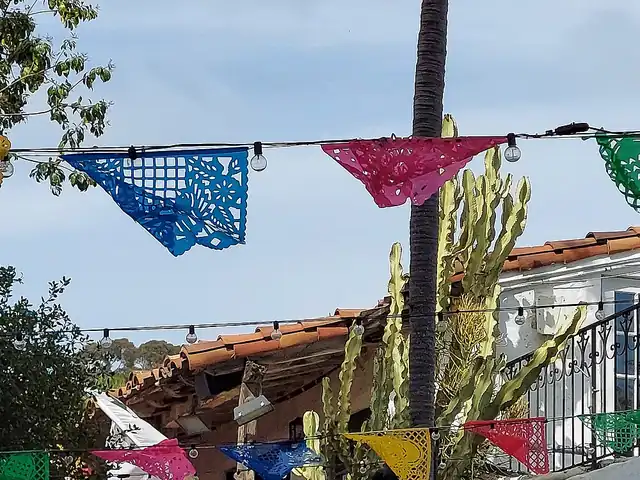
Across Mexico, families welcome back the memories of relatives who have died on 1 and 2 November. Homes and public spaces build ofrendas — tables with photographs, food, drinks, marigolds and paper banners — and papel picado is one of those banners, its fragile cut paper often read as a reminder of how fleeting life is. A printed banner is a stand-in for tissue paper; cutting and stringing it by hand is the tradition either way.
The photograph standing on the ofrenda is often an old one. If the only copy is creased or faded, the free restore old photos tools clean up a scan in your browser — nothing is uploaded.
What can I make here?
- A papel picado banner with your word on it. Type the word — a name, “Ofrenda”, anything — and print sheets with cut-out letters and punched-pattern panels between the words. Every sheet comes with dashed cut lines and a fold line for stringing. Make a papel picado banner →
- Coloring pages from your photos. A photo of a marigold, a candle, or something a loved one was fond of, turned into outlines a child can color for the ofrenda. Make a coloring page →
| Project | What you print | When it is needed |
|---|---|---|
| Papel picado banner | printable sheets — one letter per panel, pattern panels between words, dashed cut lines and a fold line for the string | as the ofrenda goes up, in the days before 1 November |
| Coloring pages | a coloring-page PDF sized for A4 or Letter | while the ofrenda is being prepared — a quiet activity for children |
When should I start?
The banner can go up as the ofrenda goes up, in the days before 1 November. Both projects print in minutes, so the honest schedule is: make them when you build the ofrenda, not weeks ahead.
What can a classroom make for Day of the Dead?
Both projects here work as printed class activities. The banner tool has an ink saver mode — “Ink saver — colour it in yourself” — that prints the same panels as black outlines on white, so a class set costs paper, not ink, and colouring the panels becomes the first step of the lesson. The punched look is printed, not cut: no craft knife appears anywhere in the job, and the only cutting is the dashed rectangle around each panel, which is scissors work.
The step split:
| Step | Who |
|---|---|
| Colour the ink-saver panels | child |
| Cut along the dashed rectangle | child, scissors |
| Fold the tab over the string, tape at the back | child — show the first one once |
| Type the word and print at 100 per cent | adult |
A one-line lesson shape: each child finishes one or two panels — two print per sheet of A4 or Letter, each panel 130 × 95 mm — and the class strings a word or a name together. “DIA DE MUERTOS” is 16 panels on 8 sheets; the longest banner the tool allows, at 18 characters, is 20 panels on 10 sheets (computed from the generator, 23 September 2026). While the banner goes up, coloring pages made from your own photos — a marigold, a candle — keep a second group busy with nothing to cut at all.
What about Hispanic Heritage Month?
Hispanic Heritage Month runs 15 September to 15 October, and both projects on this page make things for it: a papel picado banner with a word, a name or a class theme (ink saver mode prints it as outlines for a class to colour), and coloring pages from your own photos. The step-by-step with panel and sheet counts for any word is in the papel picado guide.