On this page
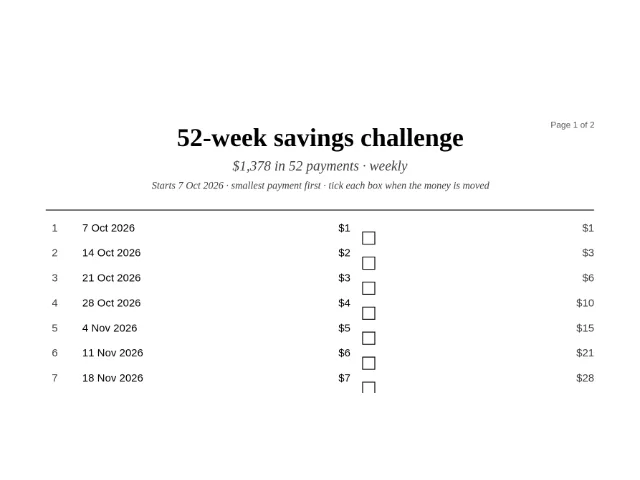
The 52-week savings challenge is the simplest savings plan that prints: put aside $1 in week one, $2 in week two, three dollars in the third week, and keep adding one dollar each week until week 52 brings $52. By the last week the pot holds $1,378.
That is the whole method. What the explainer sites leave out is that the amounts and the dates are arithmetic — and arithmetic can be computed for your number, not just the classic one. The generator above is the full tool from the tool page, running on this page: type any target, pick your payday rhythm and start date, and print a dated tracker.
How does the 52-week savings challenge work?
Each week’s deposit is that week’s number: week 7 is $7, week 30 is $30. The progression is what makes the challenge livable — the early weeks are trivially small, which is exactly the point: by the time the deposits feel large (week 40 and its $40), the habit has eleven weeks left to run, not fifty-two.
The classic total comes from the arithmetic-series sum: 1 + 2 + … + 52 = 52 × 53 ÷ 2 = $1,378. Not a round number, which is part of why it sticks — it is a real, checkable figure, and every tracker row’s running total should end on it.
What most printable trackers cannot do is carry that math to a different goal. Scaling the challenge to $5,000 uses the same shape: week k gets its share of the target in proportion to the classic progression, rounded to whole dollars, with the final week absorbing the rounding so the total lands exactly on the number you typed. The generator above states this rule on the sheet itself — the math is on the paper, not hidden in a website.
How much is each payment on the other rhythms?
Payday rhythm is where printed trackers fail real budgets: a weekly sheet does not match a biweekly paycheck. The generator folds the progression to three rhythms, all totaling the same amount:
| Rhythm | Payments | First payment | Last payment | Classic total |
|---|---|---|---|---|
| Weekly (the classic) | 52 | $1 | $52 | $1,378 |
| Every 2 weeks | 26 | $3 (weeks 1+2) | $103 (weeks 51+52) | $1,378 |
| Monthly | 12 | $115 | $113 | $1,378 |
| Any of these, reversed | same | last-first | first-last | $1,378 |
The bundled payments follow the same series: every-2-weeks payment j is (2j − 1) + 2j = 4j − 1, which is why it runs $3, $7, $11 … $103. The monthly split is even, with the twelfth payment a dollar lighter ($113) so the total stays exact — that correction is printed on the sheet, not buried in a footnote.
What if I miss a week?
The challenge dies in week four more often than week fifty, because a missed week turns into guilt and guilt turns into quitting. The arithmetic answer is cheaper: double the next deposit. Miss week 9, pay $9 + $10 = $19 in week 10, and the running total is level again.
This is the one thing a dated tracker does that an undated one cannot: because every row carries a real date, you can see whether week 12 already passed — and the catch-up is a sum you can do against the sheet, not a feeling. If two weeks slip in a row, the honest move is to reprint from today with a smaller target. The total is a choice; the habit is the asset.
Does the challenge work if I start late?
Yes — and this is the other dated-sheet advantage. The challenge takes 52 weeks from your start date, not from January 1. A start in October runs to the following September; the generator prints the exact date on every row, so “week 20” is never a guess. Starting on a payday is the practical move, because the deposit leaves with the money it came from — which is also why the every-2-weeks and monthly folds exist.
What comes after the last week?
$1,378 is a beginning, not an end. The same arithmetic-first approach runs the rest of the money bench:
- If the money is spoken for by debts, the debt snowball tracker computes the payoff order and prints a month-by-month plan — the freed minimum of every cleared debt rolls onto the next one.
- If the job is keeping bills off the wrong paycheck, the bill calendar places every bill on its due date and lists what each paycheck has to cover.
- If the job is this year’s tax papers, the tax document checklist turns your filing situations — a W-2 job, self-employment, a home, dependents — into the printed list of forms to gather.
- All four tools collect on the money hub, with the same rules: free, no sign-up, computed in your browser.
One honest boundary, stated the same way the sheet states it: these tools do the math. They are not financial advice, and no printable is a substitute for an emergency fund or a plan made with a qualified adviser.
Questions
How much money do you save with the 52-week challenge?
In the classic version, $1,378: the deposits 1 + 2 + … + 52 add up to 52 × 53 ÷ 2, and the every-2-weeks and monthly versions total the same. With the generator above, any target works — $5,000, $10,000, any number — because the same progression is scaled to the amount you type.
What if I get paid every two weeks?
Bundle the weeks: each payday covers two weeks of the challenge, so payment 1 is $3 (weeks 1+2), payment 2 is $7, and the 26th is $103 (weeks 51+52). The generator does this when you pick the every-2-weeks rhythm, and dates every payment to a real payday.
What is the reverse 52-week challenge?
The same amounts in the opposite order: $52 in week one, $1 in the last week of the year. The total is identical ($1,378); the difference is psychology — the biggest payments happen in January, when resolve is strongest, and December is cheap.
Do I have to start on January 1st?
No — the challenge is 52 weeks from whenever you begin, which is why the generator dates every row from your own start date instead of printing a fixed calendar. Starting on a payday is the practical choice, because the deposit rides the money you just received.
What happens if I miss a week?
Nothing breaks: the tracker's running total shows exactly where you are, and the catch-up is to double the next week's deposit — miss week 9 and week 10 pays $10 + $9 = $19, level again. Two missed weeks in a row are an honest signal to lower the target and restart rather than quit.
Where does the money actually go?
Anywhere separate from your spending account: a savings account, a jar, an envelope. The challenge only supplies the amounts and dates — the tool above computes and prints them; it holds no money and sees none of it, and it is not financial advice.