Key takeaways
-
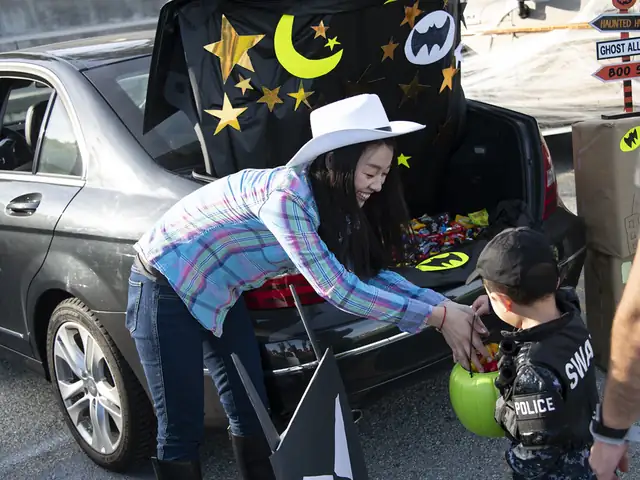
Trunk or treat is a Halloween event where decorated car boots stand in a row and children collect candy from car to car instead of door to door.
-
One contained place at one set time is the whole idea — easier to supervise than a street, and one decorated boot serves a whole queue of children.
-
The organizers are usually a parent group, a church or a neighbourhood association, and the event needs exactly three printed things: a flyer, a sign-up sheet for cars, and an entrance sign.
-
Six signed-up cars is a real event; each car brings its own candy and picks its own theme.
-
The free trunk-or-treat kit generator prints all three pieces at true size — flyer full page, entrance sign 190 × 116 mm, six-row sign-up sheet 190 × 128 mm (read from the generator's shipped code, 23 September 2026).
-
Most events run in the two weeks before Halloween, late afternoon into early evening.
On this page
Trunk or treat moves Halloween from dark doorsteps into one car park at one set time: families decorate the open boots of their cars, park them in a row, and children trick-or-treat from car to car. For an organizer it is three print jobs and one afternoon — but the order of those jobs is what decides whether the event happens at all.
What is trunk or treat?
A Halloween event where families decorate the open boots of their cars, park them in a row — a school, church or community car park — and children trick-or-treat from car to car at a set time. It exists because one contained place beats a dark street for small children, and because a boot decorated once serves a hundred children without a single doorbell. Parent groups, churches and neighbourhood associations run them; 2026 events were being published as early as August, and the planning chatter among organizers is live weeks before the events themselves.
How do you organize a trunk-or-treat event?
Work backwards from the day, in five steps:
- Fix the window first. A date in the last two weeks before Halloween, a start time in the late afternoon, one car park, one owner’s yes. Put the rain date decision here, not later.
- Recruit the cars before you advertise. Put the sign-up sheet where the adults are — the staff room, the church hall, the parents’ group chat. Each car picks its own trunk theme; themes are the fun, and a car that chooses its own theme decorates better than one assigned one.
- Flyer one to three weeks ahead. The flyer carries host, date, time, place and one note line — early enough that families can put the date in the calendar, late enough that it is not forgotten. School bags, newsletters, community boards.
- Say who brings candy. The standard deal: each car brings its own. That single sentence, in the flyer’s note line, is the difference between a volunteer afternoon and a volunteer afternoon with a budget.
- On the day, mark the entrance. The entrance sign tells arriving families they are in the right place; the sign-up sheet becomes your check-in list at the same door.
How many cars do you need?
Six is a real event. A queue of children spends under a minute at each boot, so even a small row fills a bag — the contained-place advantage works at small scale, which is exactly why small schools and single congregations run them. Twelve to twenty cars is a big one; beyond that the constraint is not cars but the car park and the candy arithmetic: if each of a hundred children visits every boot, every boot needs a hundred treats.
What makes a good trunk theme?
The evidence from this year’s chatter says interactive beats cute — an organizer’s much-shared cry of “I need interactive not just cute SOS” (September 2026) is the whole theme market in one sentence. Themes that worked in 2026 discussions and videos:
| Theme | What it is | Why it works |
|---|---|---|
| Under-the-sea | fish netting, sea creatures over and around the boot | the most-watched DIY this season (562k views); children duck under the netting |
| Shop or brand parody | a “Costco” trunk, a monopoly bank handing out candy as cash | adults laugh, children recognize it, props are cheap |
| Storybook vehicle | Ms Frizzle’s school bus, a Baba Yaga hut | one strong idea carries the whole boot |
| Games | toss, fishing pond, knock-down cans | the interactive answer — candy as a prize instead of a handout |
Two honest limits. A theme only needs to read from ten metres for the ninety seconds a family stands there — over-decorating is the common waste. And the boot itself is the shop front: decorate the open tailgate and the table in front of it, not the whole car.
What are the safety basics?
The event’s design is already the main safety measure — one car park, one time window, no moving traffic during the event. On top of that, the standard organizer baseline:
- Cars off, keys out. Boots stay open, engines stay cold, and nobody reverses until the event is over and the crowd is gone.
- A walking lane that never crosses a car. Mark where children walk; the cars stand still, the people move.
- One adult per boot. The sign-up sheet’s real job: every row is a name that has promised to stand there.
- A non-food option. Food allergies are common enough that FARE’s Teal Pumpkin Project (foodallergy.org) built a national campaign around offering non-food treats — a small bowl of stickers or glow sticks at one boot, marked, covers it.
- Light at the edges. Late afternoon start, string lights or glow sticks as the evening comes in.
How do you print the flyer, sign and sign-up sheet?
The generator prints two sheets at true size on A4 or US Letter, and every measurement below is read from its shipped code on 23 September 2026:
| Piece | Printed size | Sheet |
|---|---|---|
| Flyer — event name, host, date, time, place, note line | full page | 1 |
| Entrance sign | 190 × 116 mm | 2 |
| Car sign-up sheet — six write-in rows, two columns (name, trunk theme) | 190 × 128 mm | 2 |
Three details worth knowing before you print:
- Empty fields become write-in lines. Leave the place or note empty and the flyer prints a dashed line with a tiny label instead — a blank kit still works as a hand-out template you fill in by marker.
- Print at 100 per cent. “Actual size”, not “fit to page”, or the sign shrinks below porch-readable.
- Paper by purpose. Plain paper for the flyers you hand out by the dozen; card — or a plastic sleeve taped to a fence — for the entrance sign, which stands outside all afternoon. The ink-saver palette prints outlines only, near-zero ink for big runs.
For the rest of the event, the same site covers the neighbours: pumpkin stencils for the pumpkins beside the cars (the stencil guide walks turning a photo into the pattern), the boo basket kit if the event includes gifting, and a papel picado banner to string across the car park — the papel picado guide walks the cutting and stringing. The Halloween hub puts the whole season’s print jobs in one table, with the flyer-first order that gives other people the most notice.
Printed sizes come from the trunk-or-treat kit generator’s own code, verified 23 September 2026. Season evidence is dated September 2026 from the research notes behind the tool.
Questions
How many cars do you need for a trunk or treat?
Six signed-up cars is a real event; more is a party. A queue of children moves past each boot quickly, so even a small row gives everyone a full bag.
Who pays for the candy?
The usual deal is that each car brings its own candy — the boot is the car family's stall. Say it on the flyer, in the note line, so nobody assumes the organizers supply everything.
Do we need a permit to hold one?
It depends on whose car park you use and whether the public is invited. The owner's yes is the minimum; schools, churches and community centres usually know what else the town wants for a public event, so ask them first.
Should the event be in the dark?
Most run late afternoon into early evening — one 2026 church event runs 5 to 7:30 pm — because light is part of the point for small children. Glow sticks and string lights extend the evening without making it a night event.
What if it rains?
Put a rain date on the flyer, or pick a car park with a roof. The entrance sign and sign-up sheet stay valid either way; only the date line changes.