On this page
A letter from Santa is the parent’s job twice over: somebody writes what Santa noticed this year, and somebody gets the paper into the house. The maker above does the printing; this guide is the wording. It gives the five-part formula, a full sample for a toddler, a first reader and a confident writer, all three taken from the maker’s own voices, and an honest table of the free and paid routes, North Pole postmark included. Everything happens in your browser; nothing you type is sent anywhere.
What should a letter from Santa say?
Four short paragraphs are a complete letter. The formula:
- The child’s name, the first word, spelled exactly right. Every other sentence survives being ordinary; the name does not.
- Two or three true things from this year. Small and specific beats grand and vague: “was brave at the dentist” is a sentence a child recognizes as their own; “was a good girl” is a sentence any child could receive.
- One thing to keep practicing, said kindly. One, not a list. This letter comes from a fan of the child, not a second report card.
- One wish, and only if it will really be under the tree. The maker’s own field label says so: an unkept promise from Santa is the one mistake this letter cannot survive.
- A North Pole detail and the signature. Where Santa will fly over, who is practicing loop-the-loops, and “Santa” at the bottom. Details about the workshop, never about how the present was made.
Write it as Santa speaks: short sentences, “you” more than any other word, and one surprise per paragraph at most.
What should Santa never write?
| Never | Why it backfires | Write instead |
|---|---|---|
| Naughty-list warnings | fear is the wrong souvenir, and siblings quote it against each other all year | a good deed, plus one gentle keep-practicing line |
| A named promised gift (“I am bringing the purple bike”) | a promise the tree cannot keep undoes the whole letter | a wish, only once it is already bought, or no wish at all |
| Surveillance lines (“I saw you hit your sister at the shop”) | the letter stops being a gift and becomes a threat with a postmark | deeds the child is proud of, in the family’s own words |
| Making-of details (“my elves cut the wood for your kitchen”) | the tag on Christmas morning tells a different story, and an eight-year-old does the math | magic that lives at the North Pole, never in a factory |
That last row is the one parents learn the hard way: keep every claim about the child and the year, because every claim about the present gets checked.
What do you write for a 3-year-old, a 6-year-old, an 8-year-old?
The maker has three voices, and the ages are guidance rather than law: switch by the child, not the birth year. Short prints five lines in bigger type, for letters that get read aloud to two-to-five-year-olds. Warm and classic is the letter most grown-ups remember receiving. Funny hands the jokes to the elves, for children who have started to wonder.
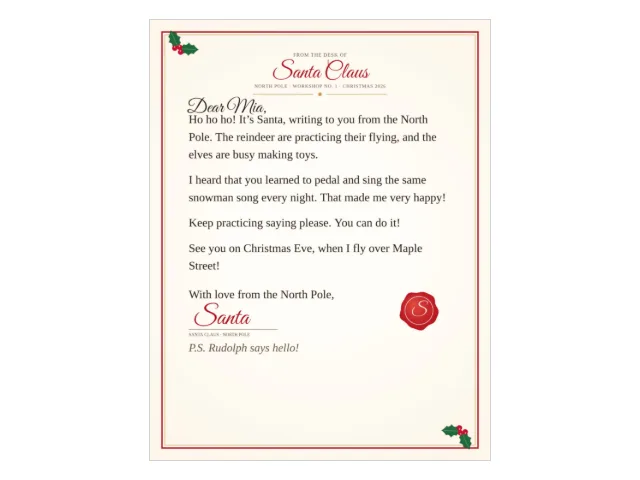
A 3-year-old (short voice). Typed in: Mia, street Maple Street, two good things (“Learned to pedal”, “Sing the same snowman song every night”), one practice (“Saying please”). The letter prints like this:
Ho ho ho! It’s Santa, writing to you from the North Pole. The reindeer are practicing their flying, and the elves are busy making toys.
I heard that you learned to pedal and sing the same snowman song every night. That made me very happy!
Keep practicing saying please. You can do it!
See you on Christmas Eve, when I fly over Maple Street!
P.S. Rudolph says hello!
An optional age field adds a line about how big the child is now, spelled out in words; leave it empty and the sentence simply drops, which keeps the letter inside a toddler’s attention either way.
A 6-year-old (warm and classic). Typed in: Emma, 6, Maple Street, three good things (“Learned to ride a bike”, “Helped with the dishes”, “Was brave at the dentist”), one practice (“Going to bed on time”), one wish (“the art set”). The letter opens:
Ho ho ho! I am writing to you from my workshop at the North Pole, where the snow is deep, the elves are humming and Mrs. Claus has just taken the first gingerbread out of the oven.
I have been keeping an eye on you this year, and I am very proud of you. Here is what the elves wrote in my big book:
★ Learned to ride a bike
★ Helped with the dishes
★ Was brave at the dentist
Six is a wonderful age. You are growing so fast that I had to check twice that it really was you!
One little thing to keep working on: going to bed on time. I know you can do it, and the elves are cheering for you.
I have your wish list right here on my desk, with the art set near the top. The elves have been reading it very carefully.
and closes over Maple Street, asks everyone to be asleep so the sleigh can land, and signs “Keep being kind, Emma. Merry Christmas!”, with a P.S. about Rudolph’s extra-shiny nose.
An 8-year-old (funny). Typed in: Leo, 8, three good things (“Read a whole chapter book alone”, “Learned to whistle”, “Built the tallest Lego tower so far”), one wish (“the ice skates”). The letter opens:
Greetings from the North Pole, where it is very cold and very busy. The elves have eaten three hundred candy canes this week, and Dasher has been practicing loop-the-loops again. Mrs. Claus says he is showing off.
The elves keep a very big book about you. I peeked, and here is what it says:
★ Read a whole chapter book alone
★ Learned to whistle
★ Built the tallest Lego tower so far
You are 8 now. That is 56 in reindeer years, which is very grown-up indeed.
I have your wish list right here on my desk, with the ice skates near the top. The elves have been reading it very carefully.
The reindeer-year line is the maker doing arithmetic, not a coincidence: it multiplies the age by seven (computed October 2026). The letter closes with the same sleepy-town line as the classic voice, and then the funniest P.S. of the three: “P.S. If you leave out a carrot, Rudolph will be very grateful. Dasher says he prefers cookies, but don’t tell him I told you.”
For a child who has started asking how one person visits every house, the funny voice is a better answer than any explanation: it gives the North Pole more staff and more personality.
How do you make the letter feel real?
The formula is the skeleton; four details do the convincing.
- The family’s own words for the deeds. Not “was good” but “sing the same snowman song every night”. Type the phrase your household actually uses; the child hears it.
- The street or town Santa flies over. One optional field, and the one that sends a child to the window.
- The reply. If your child wrote to Santa first, answer one thing from their letter. The Christmas wish list maker prints their letter, and the letter you make here is the answer to it.
- The staging. Print at 100 percent, not fit-to-page, so the border sits evenly; plain paper works, and heavier paper (about 120 g/m², or 32 lb) feels like real mail. Fold the letter in thirds, then choose the moment: in the stocking, beside the half-eaten cookies, taped to the bedroom door. The Nice List certificate prints on its own landscape page and is a fridge job.
For the presents the wish named, photo gift tags with a photo inside carry the family’s own pictures into the morning.
Do you need a paid personalized letter?
| Route | Cost | What arrives | Watch for |
|---|---|---|---|
| The maker on this page | free | the letter plus a Nice List certificate as a PDF you print | you pick the voice and the details; minutes of typing |
| A paid vendor letter | priced per letter on the vendor’s own order page (checked 25 October 2026) | a printed letter produced and mailed to your child; some vendors email a digital copy | two clocks, production and postal transit; there is no universal deadline |
| USPS North Pole Postmark, “Greetings from the North Pole” | free; you supply two stamped envelopes | your own reply, postmarked North Pole, delivered to the child | USPS recommends mailing it to Anchorage between November 23 and December 1 (checked 25 October 2026); every word is yours to write first |
| USPS Operation Santa | free to join | a stranger may adopt the wish list and send a gift | letters to 123 Elf Road must be postmarked by December 5, 2026 (checked 25 October 2026); no reply or gift is guaranteed |
The honest comparison: a paid letter buys the parent’s time, not better words. The words are the formula above no matter who types them. The postmark route is real and free, and the postmark itself is the magic; it is also the only route that cannot start until the letter is completely written, which is the part this guide is for.
How does the North Pole postmark work?
USPS’s “Greetings from the North Pole” is a postmark service, not a writing service. Santa’s reply has to be complete before it leaves your house:
- Write the reply (the formula above works as-is), sign it, and put it in a stamped envelope addressed to your child.
- Put that envelope inside a larger stamped envelope addressed to: North Pole Postmark, Postmaster, 4141 Postmark Drive, Anchorage, AK 99530-9998.
- Mail it in the recommended window, November 23 to December 1 (checked 25 October 2026). The Anchorage post office cancels the inner envelope with the North Pole postmark and puts it in the mail to your child.
Postal guidance can change by season, so check the official USPS letters-from-Santa page (about.usps.com/holidaynews/letters-from-santa.htm) the week you mail. Operation Santa is the separate wish-list program at 123 Elf Road, North Pole 88888: letters must be legible, carry correct postage and a full return address, and be postmarked by December 5, 2026 (checked 25 October 2026). Being posted, adopted and answered are all possible rather than promised, per the USPS Operation Santa FAQ (checked 25 October 2026).
The letter is one page of one evening. The Christmas printables hub lines up the rest of the season, and the last-minute printable Christmas gifts guide sorts the makers by how much time is left.
The three sample letters are the maker’s own assembled wording for the typed details shown, checked against the tool on 25 October 2026. The USPS windows and dates are the official program pages’, linked and dated; the vendor price belongs on the vendor’s live order page, so none is printed here.
Questions
What do you put in a letter from Santa?
Five things: the child's name, two or three true things from their year, one keep-practicing line, one North Pole detail and Santa's signature. The maker on this page assembles all five from a short form.
How do you sign a letter from Santa?
'Santa' is enough for a toddler; 'Santa Claus' with a flowing signature suits a child who studies handwriting. The maker prints the signature in Santa's own script, and a P.S. from Rudolph comes with it.
What do you write in a reply letter from Santa?
Answer one specific thing your child's own letter said or asked, the way someone who read it carefully would. The Christmas wish list maker prints their letter, and yours is the answer to it.
Is there a free template for a letter from Santa?
The maker on this page is free and computes the whole letter from your details, name to signature, on Letter or A4 paper. A template with a blank line for the name is the thing it replaces.
Does the post office send letters from Santa?
USPS postmarks your own written reply from the Anchorage post office if it arrives in the recommended November 23 to December 1 window (checked 25 October 2026). Operation Santa is a different program: wish lists may be adopted by strangers, and no reply is guaranteed.
How long should a letter from Santa be?
Four short paragraphs, about a minute read aloud. The maker's short voice prints five lines in bigger type on purpose, because a toddler's attention ends before a second paragraph does.