Key takeaways
-
A rangoli stencil is a sheet with the pattern cut out: lay it flat, dust flour, coloured sand or flower petals over the holes, lift the sheet away — the pattern stays on the ground.
-
A printed stencil needs a printer, paper, a craft knife and tape; the free generator prints any size from 15 to 120 cm across at true scale, in centimetres you choose.
-
Big rangolis print as tiles: 45 cm takes 6 sheets of A4 (3 × 2), 90 cm takes 19 of a 5 × 4 grid — the design is round, so the empty corner positions carry no stencil lines and the PDF skips them — the generator's own tiling, computed 23 September 2026.
-
Two styles exist, and the filler decides: cut lines for fine detail with sand or powder, dot grid for flour and petals.
-
Dot counts are fixed geometry, not guesswork: at the generator's 9 mm spacing, a 45 cm twelve-petal lotus in dot style needs 737 punched holes.
-
A beginner rangoli is 30 to 45 cm across — four to six sheets, and under an hour from printer to floor.
On this page
A stencil takes the one skill out of rangoli that stops most people — the drawing. What is left is printing, cutting, taping and dusting: real work, but work with knowable answers. How many sheets? How many holes? How long? All of it is computable before you start, and this guide carries the numbers computed from the free rangoli stencil generator on this site — read from its code and verified against the running tool on 23 September 2026, not estimated.
What is a rangoli stencil?
A thin sheet — paper or plastic — with a rangoli pattern cut out of it. You lay it where the decoration goes, dust powder or petals over the whole surface, and lift it: colour stays only where the holes were. Physical stencils are a normal, widely sold product — online sellers moved them at roughly US$3.50–5 each in September 2026 — precisely because they answer the loudest want-voice in the rangoli chatter: beautiful, but I cannot draw. The printed version answers it for the price of paper: the generator draws the pattern, tiles it to true size, and hands you the PDF.
One honest limit before anything else: a paper stencil for powder is a cousin of the tradition, not a replacement for the art. Freehand rangoli and kolam drawing are skills people practise for years, and stencils are the modern shortcut sitting beside them — sold in shops, used in homes, drawn by neither pride nor shame.
How do you make a rangoli with a printed stencil?
Five steps, and the PDF carries the instructions on its last page:
- Print every sheet at 100 per cent — “actual size”, not “fit to page”. At any other setting the whole rangoli shrinks, and 45 cm quietly becomes 42. Every tile page says so at the bottom.
- Trim and tape. Cut along the dashed trim lines, then tape the sheets together from the back, row by row. The PDF’s first page is an assembly map showing which sheet goes where — every sheet is labelled “sheet 3 of 6 (row 2, column 3)” style, so the map is hard to misread.
- Cut the black parts out. Craft knife, cutting mat, centres first so the paper stays rigid. In dot-grid style you punch round holes instead of cutting strips.
- Lay and weigh. Flat on the spot, corners weighed down. Dust in one direction, sweep the excess off with your hand.
- Lift straight up in one movement. Wobbly edges get touched up by hand afterwards — small wobbles are what make it yours.
Practise the lift once on newspaper. It is the only step with a technique to it.
How many sheets will my rangoli need?
The generator tiles the design across A4 sheets with a 192 × 265 mm printable window each (A4 minus 9 mm printer margins and a 14 mm label strip). Sheet count follows from the size you type, and these are the tool’s real numbers, verified 23 September 2026:
| Size across | A4 sheets | Grid | PDF pages |
|---|---|---|---|
| 30 cm | 4 | 2 × 2 | 6 |
| 45 cm | 6 | 3 × 2 | 8 |
| 60 cm | 11 | 4 × 3 (1 skipped) | 13 |
| 90 cm | 19 | 5 × 4 (1 skipped) | 21 |
| 120 cm (the maximum) | 32 | 7 × 5 (3 skipped) | 34 |
Two patterns hide in that table. Sheet count grows with area, not width — doubling 45 cm to 90 cm more than triples the sheets (6 → 19), because the grid grows in both directions. And the PDF always adds two pages: the assembly map in front and the how-to page at the end, which is why 6 sheets means 8 pages.
The skipped corners need one honest sentence: the design is a circle, the sheet grid is a square, so the corner positions of the grid fall outside the circle. They carry no stencil lines at all — nothing to cut — so the PDF skips them, the assembly map marks them “no stencil lines — not printed”, and the sheet numbers run over the sheets you actually print while every sheet keeps its row-and-column position. At 45 cm and below the circle fills the whole grid and nothing is skipped.
The festival arithmetic is plain: for Navratri or Diwali doorstep duty, 30 to 45 cm is an evening’s craft. A 90 cm courtyard rangoli is a deliberate project — 19 sheets, and a taping session on the floor.
Cut lines or dot grid — which style?
The generator’s two styles split exactly along what you dust through them:
| Cut lines | Dot grid | |
|---|---|---|
| What you cut | full outlines of every petal and lamp | round holes along every line |
| Knife work | slower, precise | faster — holes punch out cleanly |
| Best filler | fine sand, rangoli powder | flour, flower petals |
| The finished look | continuous drawn lines | the classic dotted kolam style |
Dot-grid counts are the tool’s most quotable numbers, because the spacing is a fixed 9 mm between hole centres (each hole ≈ 4.8 mm across) and the count follows from the geometry. For the default twelve-petal, three-ring lotus:
| Size across | Holes to punch |
|---|---|
| 30 cm | 564 |
| 45 cm | 737 |
| 60 cm | 983 |
| 90 cm | 1427 |
(Computed from the generator’s geometry, verified against the running tool, 23 September 2026.)
The dot-grid motif family — pulli kolam, the dotted tradition — has its own formula: at k rings the grid is m = 2k + 3 dots per side. One ring gives a 5 × 5 grid (25 dots), two rings 7 × 7 (49 dots plus 36 woven diamonds — 85 shapes to cut), three rings 9 × 9 (81 dots, 145 shapes), four rings 11 × 11 (121 dots). Choose it when the dotted look is the point.
Which motif and size should a beginner pick?
Measure the spot first, then pick the motif. Doorsteps and hallways take 30 to 45 cm; courtyards and porches 60 to 90 cm; big courtyard rangolis run over a metre. On motif, the generator’s ten families divide cleanly by mood:
- Floral and classic: lotus, daisy, leaf garland — the safest first pick, readable from any angle.
- Festival lamps: diya lamps ringing the centre — the Diwali motif.
- Geometric: star, mandala, wheel, diamond lattice — sharp, symmetrical, dense at higher petal counts.
- The dotted tradition: pulli kolam dot grid — when the dotted style is the point.
- Paisley drops sit between floral and geometric.
Petals run 6 to 24 per ring, rings 1 to 4; start at 12 petals × 3 rings (36 shapes to cut in outline style) and move up only if the last one went well. A single middle letter — an initial — is a popular touch for doorways and name-day decorations; the generator centres it in the motif’s hub. And the print is always black outlines or dots on white, never filled colour areas: line work only, which keeps the ink cost near zero and leaves every colour decision to the powder.
What do I fill the stencil with?
Three fillers, each matched to a style:
- Rice flour — the traditional white, through dot-grid holes.
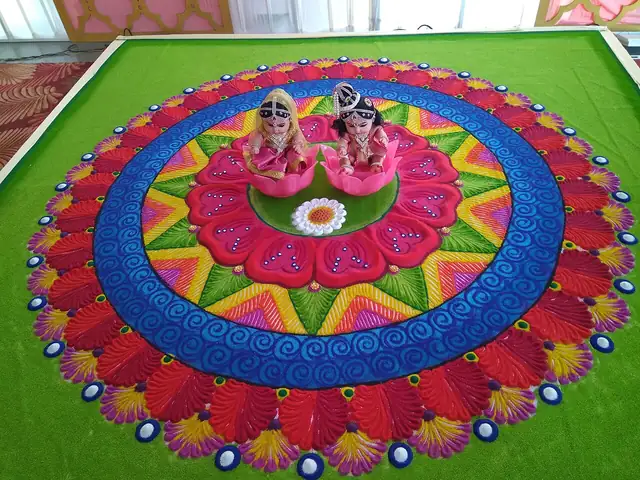
- Coloured rangoli powder or sand — the bright photographed look, fine enough for cut lines too.
- Flower petals — through round dot holes only; petals bridge and jam in thin cut strips.
Dust in one direction, sweep the excess off with the flat of your hand, and lift the sheet straight up in one movement. Wobbly edges are touched up by hand — and if the festival rush is the real constraint, the same site has the neighbours: a colouring page made from a photo keeps children busy on the same afternoon, and a papel picado banner strings the door while the rangoli holds the floor — the papel picado guide walks the cutting and stringing. For a class or a group of children, the Diwali hub’s classroom section says which steps are child work and which stay with an adult.
Every sheet count, dot count and formula above is computed from the rangoli stencil generator’s own geometry and was verified against the running tool on 23 September 2026. Seller prices are from the September 2026 research scan behind the tool.
Questions
Can I make a rangoli if I can't draw?
Yes — that is exactly what a stencil is for: sellers who ship plastic stencils advertise them with "can't draw? use a stencil", and the printed version does the same job for the price of a few sheets of paper.
What powder do I dust through a rangoli stencil?
Plain rice flour for the traditional white lines, coloured rangoli powder or sand for the bright look, or flower petals — but petals only work through the round holes of the dot-grid style, not through thin cut lines.
How do I stop the stencil from moving while I dust?
Weigh the corners down, dust in one direction, sweep the excess off with your hand, and lift the sheet straight up in a single movement. Practise the lift once on newspaper before the real spot.
Can I reuse a paper rangoli stencil?
One or two careful uses, yes. For many uses, have the printed sheets laminated or copied onto a plastic folder sheet at a copy shop, then cut the holes out of the plastic — that also survives a damp floor.
Is using a stencil instead of drawing cheating?
Stencils are a normal, widely sold modern shortcut, and plenty of households use them. Freehand drawing is the traditional art and practising it is part of the fun for many people — both belong to the festival.
What size rangoli should a beginner make?
30 to 45 cm across — a doorstep rangoli at that size takes under an hour from printer to floor and four to six A4 sheets. Measure the spot first — doorsteps and hallways take 30 to 45 cm, courtyards 60 to 90 cm, big courtyards over a metre.