Key takeaways
-
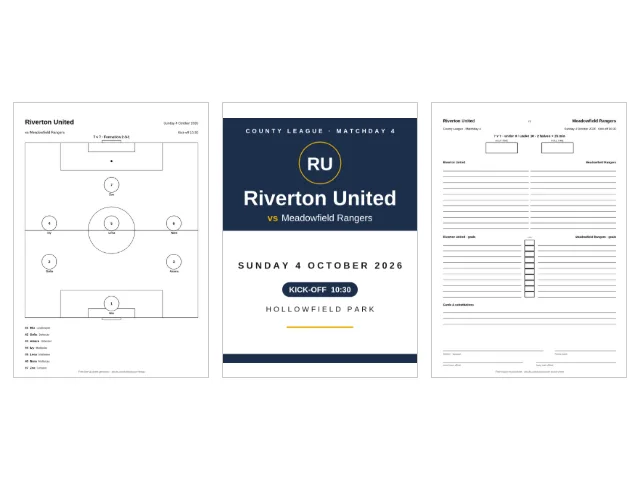
A volunteer youth soccer coach needs three printed things on game day: a line-up sheet with every player's name for the referee, something to keep score on, and a poster that tells families when and where the team plays.
-
The game format follows the age group: under 7 and under 8 teams usually play 5 v 5, under 9 and under 10 play 7 v 7, under 11 and under 12 play 9 v 9, and from under 13 the game is the full 11 v 11.
-
Match length grows with the format: 2 × 20 minutes at 5 v 5, 2 × 25 minutes at 7 v 7, 2 × 30 minutes at 9 v 9, and from 11 v 11 two halves of 35 minutes rising to 45.
-
The ball also follows the age group — size 3 for the youngest teams, size 4 for the middle years, size 5 from 11 v 11 — but federations disagree at the edges, so the league handbook is the final word.
-
The free line-up sheet generator prints the referee's team sheet and the coach's pitch plan on one A4 page, filled in or blank, and the match-day poster maker prints the fixture for the notice board and a phone-size picture for the team chat.
-
A printed sheet cannot track whether every child plays their fair share of the game — that tally stays with the coach's pencil.
On this page
The email says your child’s team needs a coach, and by Thursday you have said yes. By Saturday you need the same paperwork every volunteer coach needs, printed at the kitchen table: who plays where, on which sheet, for how long, and something that tells the other families when to show up. This page walks the whole game-day folder, with the numbers that decide it — and the tools that print it.
What does a volunteer coach need on game day?
Three printed things and one pencil:
- A line-up sheet — the pitch with every player on it, plus the roster list. It is your plan during the game and, where the league wants one, the team sheet you hand to the referee.
- Something to keep score on — the margin of the same sheet is enough (more on this below).
- A match-day poster — one A4 page for the clubhouse notice board, one phone-size picture for the team chat.
The order matters more than the paper. Work backwards from kick-off:
- Two or three days before: put the poster out. Families plan weekends early; a fixture that arrives on Saturday morning arrives too late. The match-day poster maker turns the six facts a fixture needs — club, opponent, competition, date, kick-off, venue — into that A4 sheet and the chat picture in the same step.
- The evening before: fill the line-up sheet. Pick the game format your league plays, pick a formation (how the players are spread over the pitch), type names and shirt numbers, print two copies — one for the clipboard, one for the referee. Print a spare blank one too. If the sheet is for the notice board or a stand-in coach, the lineup maker with pictures prints the same formation with every player’s photo on it.
- At the field: hand in the sheet where required, count shirts against the roster (the player who slept in is found now, not in the third minute), and start the pencil tally for playing time.
- During the game: goals in the margin, subs as you make them. The referee keeps the official score; yours is for the result card or the chat.
Bring the right ball as well — the league does not supply it, the home coach does. Which ball that is follows the age group, like everything else on this page.
Which game format does my team play?
The format follows the age group, on a ladder that is nearly the same across countries: 5 v 5 for under 7 and under 8, 7 v 7 for under 9 and under 10, 9 v 9 for under 11 and under 12, and the full 11 v 11 from under 13. Every row of the table also tells you the pitch to expect, the ball to bring and how long the match runs.
| Age group | Game format | Players per team | Approx. pitch size | Ball | Match length |
|---|---|---|---|---|---|
| Under 7 / Under 8 | 5 v 5 | 5 (4 + goalkeeper) | about 40 × 25 m | 3 | 2 × 20 min |
| Under 9 / Under 10 | 7 v 7 | 7 (6 + goalkeeper) | 55–65 × 35–45 yd (≈ 50–59 × 32–41 m) | 4 — England: 3 | 2 × 25 min |
| Under 11 / Under 12 | 9 v 9 | 9 (8 + goalkeeper) | 70–80 × 45–55 yd (≈ 64–73 × 41–50 m) | 4 | 2 × 30 min |
| Under 13 and older | 11 v 11 | 11 (10 + goalkeeper) | 90–120 × 45–90 m | 5 | 2 × 35 min, rising to 2 × 45 |
Every number above is read from a governing body’s own document, and the federations do not fully agree — this is the part most cheat sheets get wrong:
- England moved the ladder in the 2026-27 season. Under its new FutureFit pathway each format now arrives a year later: 3 v 3 at under 7, 5 v 5 up to under 9, 7 v 7 up to under 11, 9 v 9 up to under 13, and 11 v 11 only from under 14. The FA also keeps a size 3 ball through under 11 — including 7 v 7 — and caps match-day squads at 10 players (5 v 5) and 14 (7 v 7). (The FA, Know Your Format and Mini-Soccer Handbook 2026-27, read 24 September 2026.)
- The United States plays the same ladder one step down at the bottom. The 2017 US Youth Soccer standards matrix has 4 v 4 without a goalkeeper at under 6 to under 8; the current US Youth Soccer playing rules (approved June 2026) allow under-8 teams up to five players and still describe four as the recommendation. The same documents give two 25-minute halves at under 10, two 30-minute halves at under 12, and 11 v 11 with a size 5 ball and two 35-minute halves from under 13. (USYS Policy on Players and Playing Rules, June 2026, and the Player Development Initiatives matrix, 2017 — both read 24 September 2026.)
- Germany mixes formats at the young ages rather than fixing one per season — under 8 to under 11 afternoons rotate 3 v 3, 5 v 5 and 7 v 7 on small pitches (5 v 5 about 40 × 25 m, 7 v 7 about 55 × 35 m), with a size 3 ball in the youngest years and size 4 from the under 10s. (DFB, Spielformen im Kinderfußball, 2019, read 24 September 2026.)
- The full pitch at 11 v 11 is 90–120 m long and 45–90 m wide for domestic football. (IFAB Laws of the Game 2026/27, Law 1, read 24 September 2026.)
The table follows the classic 5v5–7v7–9v9–11v11 ladder because it is the read most leagues’ handbooks still print and the one our line-up sheet generator is built around — and the generator shows its arithmetic (“7 players: 1 goalkeeper, 2 defenders, 3 midfielders, 1 forward”) before you print, so a mismatch with your league is caught at the kitchen table, not at the touchline. When your handbook says something else, the handbook wins.
What goes on the team sheet I hand to the referee?
Less than you fear: the players’ names, their shirt numbers, and the age group or format — usually on one page, usually collected at the coach’s meeting before kick-off. Referees check names against numbers; they do not want your tactics.
That is why the line-up sheet works as the team sheet: the roster block under the pitch lists every player in order with number and role written out, and the header carries team, opponent, date and kick-off. Two practical habits:
- Print at “actual size”, not “fit to page”, so the pitch keeps its proportions and the sheet stays readable in the sun.
- Print a blank spare. On Saturday morning the team is often only final at the field — a sick player, a borrowed shirt. The blank sheet with every position and role marked still works, filled in by hand.
If you coach the same team every week, the generator remembers your last sheet in the browser, so match morning is one changed name, not a retyped roster. Nothing you type is uploaded; the PDF is drawn on your own device.
How do I keep score at a youth match?
On paper, in the margin — the referee keeps the official record, so yours only has to be true for your own purposes. The honest minimum that later answers every question (the league result card, the parent asking “who scored?”, the chat message):
- Each goal: shirt number and the time — “7 — 12th min” is enough. The clock restarts each half, so for small-sided games (5 v 5 to 9 v 9) “2nd period” instead of a minute is fine.
- Substitutions as you make them, marked next to the roster rows — this doubles as your playing-time tally.
- The half-time and full-time scores written large enough to read back to the league’s result system.
If you would rather keep that record as its own page than in the margin, the soccer score sheet generator prints it — rosters for both teams, the goal log, half-time and full-time boxes, and the half lengths for your age group — on one A4 sheet.
The printed line-up sheet deliberately has no score box: a score box invites keeping two records, and only one of them counts. Use the back of the sheet if the game produces more than the margin can hold.
How do I tell families when and where the match is?
With the poster, in both places families actually look: the clubhouse notice board and the phone. The match-day poster maker prints both from one set of details — a true A4 page for the board, typed and spaced to be read across a room, and a 1080 × 1350 pixel picture with no watermark for WhatsApp or the club’s social page. If you have a club crest (the club’s badge or logo) it goes at the top; if not, the club’s initials are drawn in a ring, so the poster never looks half-finished. The crest and every detail you type stay on your device.
Two habits worth copying from clubs that do this well: print the poster on the Monday of match week (Saturday-morning fixtures are planned during the week), and put the away venue’s address on it, not just the ground’s name — half the “where is it?” messages are about that.
What can a printed sheet not do?
Being honest about this is the difference between a tool and a toy:
- It cannot track playing time. Both major rulebooks make fair shares the coach’s job — US recreational league rules require at least half a game per player, and the English FA writes “equal playing time where possible, with a best practice recommendation of at least 50% per player” into its mini-soccer handbook. No printed page counts minutes; a pencil tally next to the roster rows does.
- It goes stale the moment a player does not turn up. Print the blank spare; a hand-filled sheet beats a wrong one.
- It does not remind anyone. The sheet is for the day; the poster in the team chat is what makes families arrive on time.
- It is not the official record. The referee’s card is. Yours is for the league’s result system and for telling the story in the chat.
Everything on this page is collected on the sports hub as the pillar grows — the line-up sheet, the poster and the score sheet today, and the practice plan generator for the evenings between matches. All of it free, no account, nothing uploaded.
Sources, read 24 September 2026: The FA Know Your Format and Mini-Soccer Handbook 2026-27 (formats, balls, durations, squad caps, playing-time best practice); US Youth Soccer Policy on Players and Playing Rules (approved June 2026; game lengths, balls, player maxima, recreational half-game rule) and Player Development Initiatives (2017; pitch ranges); DFB Spielformen im Kinderfußball (2019; German pitch sizes and balls); IFAB Laws of the Game 2026/27, Law 1 (full pitch). Yard-to-metre conversions computed from 1 yd = 0.9144 m.
Questions
Do I have to hand the referee a team sheet?
It depends on your league — many collect one at kick-off, many only at tournaments. Where it is needed, the roster block of the line-up sheet carries every name, number and role; leaving the names empty prints a blank sheet you fill in at the field.
What size ball does my team use?
Roughly: size 3 for the youngest teams, size 4 through the 7 v 7 and 9 v 9 years, and size 5 from 11 v 11. England now keeps a size 3 ball up to under-11s, so the league handbook is the final word.
How long is a youth soccer match?
About 40 minutes total at 5 v 5, 50 at 7 v 7 and 60 at 9 v 9, played as two equal halves. At 11 v 11 youth games run two halves of 35 minutes, growing to two 45-minute halves by under-17.
How do I keep score during the game?
Write each goal on the sheet's margin or the back — the scorer's shirt number and the minute or period is enough. The referee keeps the official record; your tally is for the result card or the team chat.
How do I make sure every child plays enough?
Plan on at least half a game per player — that is the standard rule in US recreational leagues and the English FA's written best practice. A printed sheet cannot track minutes, so keep a small tally next to each roster row.
Where do the three printouts come from?
All three print from this site for free: the line-up sheet generator, the match-day poster maker and the score sheet generator — or the plain score margin on the line-up sheet if you would rather carry one page. Nothing is uploaded and there is no account.