What the tool computes, and what it does not
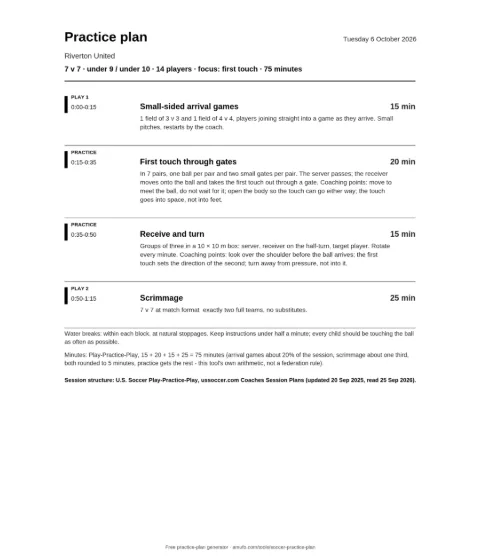
The plan has four timed blocks, and their arithmetic is on the page before you print:
- Play 1 — arrival games. How many fields of 3 v 3 your player count makes, with the odd player accounted for honestly (as a floating neutral — one player who plays for whichever team has the ball — not by ignoring them).
- Practice — two activities for your focus, each with its organization for your numbers and two or three coaching points.
- Play 2 — scrimmage at match format, with the substitute count computed from your attendance — and if you are short of two full teams, a smaller-sided game stated as such.
What it does not do: it does not track your season, does not know your league’s rules, and does not replace a coaching qualification. The drills are standard grassroots practice, not a curriculum. Bring your own judgment about your players.
The printout is one page, A4 or US Letter, black on white — it works on the clubhouse printer. The footer states the structure source (U.S. Soccer’s published session plans) and that the minutes are this tool’s computation, so nobody at the club meeting mistakes it for a federation document.
Why play-practice-play
A youth session that starts with a line of children waiting for a turn has already lost. The play-practice-play order — small-sided games, then a focused practice block, then a scrimmage — keeps every player in a game at every stage, and it is the structure U.S. Soccer builds its published grassroots session plans around. This tool takes that order and does the arithmetic you would otherwise do on the back of an envelope: the minute split, the field count, the substitutes.
The full walk-through — why play comes first, how the minutes split at 60, 75 and 90, and what to do with six players — is in the youth soccer practice-planning guide.
For match day, the same club needs different paper: the line-up sheet generator prints who plays where, the score sheet generator keeps the goals, and the game-day guide walks the whole match morning. For the other evenings of the week, this page is the one that gets you out of the car with a plan.
Nothing you type leaves this page: the computation, the print and the PDF all happen locally in your browser.
Questions
Is this the official U.S. Soccer practice plan?
No — and it does not claim to be. The plan follows the play-practice-play structure that U.S. Soccer's published grassroots session plans use (session starts with small-sided play, moves to a focused practice block, ends with a scrimmage). The block minutes, the drill picks and the small-sided arithmetic for your player count are computed by this tool, on your device, and the printout says exactly that.
How are the minutes worked out?
Arrival games get about 20 % of the session, the scrimmage about one third, both rounded to the nearest 5 minutes, and the practice block gets the remainder, split into two activities. For a 75-minute session that is 15 minutes of arrival games, 20 + 15 minutes of practice, 25 minutes of scrimmage — 75 exactly, every time. The rounding rule is ours, not a federation's, and the plan says so.
Why does the session start with games instead of a warm-up lap?
Because children arrive scattered, and a small-sided game is a warm-up they will actually join. The first block absorbs late arrivals — each player steps straight into a game — and the same structure is what U.S. Soccer's session plans are built around.
What if only six players turn up?
Set the player count to what you actually have — the small-sided games and the scrimmage re-compute. With six players at 7 v 7 the scrimmage honestly becomes 3 v 3, and the plan says you are short of two full teams instead of pretending otherwise.
Can I use it for a full season of sessions?
Each visit computes one session plan for one focus. There is no season calendar and no progress tracking — that is work for your coaching folder. What it does do is take the arithmetic off you: how many fields of 3 v 3 twelve players make, when the scrimmage starts, how the minutes split.
Is anything uploaded from this page?
No. The plan is computed and drawn into the PDF entirely inside your browser. No account, no watermark, and no request carries anything you typed.