How do these place cards work?
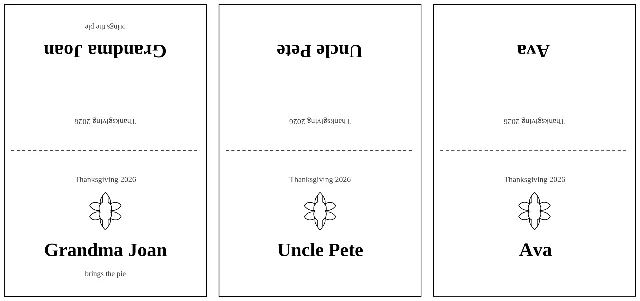
You type, the page prints. Each line in the box above becomes one card: the name in a large serif, an autumn line drawing above it, and — if you add one — a small note underneath. Four cards print per sheet, in a grid with cut and fold marks. No decorating skills, no spreadsheet, and above all no handwriting twenty names into little tents while the potatoes boil.
The cards are finished, not blank. That is the whole idea: blank place-card templates are easy to find, but then you still handwrite every name. Here the typed list becomes the printed card.
| Paper | Cards per sheet | Card size | Folded tent |
|---|---|---|---|
| A4 | 4 | 90 × 130 mm | 90 × 65 mm |
| US Letter | 4 | 85 × 124 mm | 85 × 62 mm |
Print at 100 percent — not “fit to page” — and the fold lands exactly on the dashed line.
What should I write on a place card?
The name, first and foremost. A place card has one job: telling Aunt Vera where she sits. Beyond that, the optional note is where hosts get clever — keep it short:
- the dish someone brought:
Uncle Pete | mashed potatoes, as every year - a memory or thank-you:
Ava | sat at the kids' table for the last time - nothing at all. A name alone is a finished card.
Long notes shrink to fit; a few words look best.
Why type them instead of writing by hand?
Handwriting works, and for a table of six it is arguably nicer. Typed cards win when the table is long (twenty names is twenty chances to run out of patience), when handwriting is shaky, or when you simply want the table set an hour earlier. The three motifs — maple leaf, wheat, pumpkin — are quiet line drawings that survive any printer, including the black-and-white one in the office you borrow on the Wednesday before.
What this tool deliberately does not do: it does not plan your seating (who sits next to whom is a family question, not a tool question), and it does not draw custom art per guest. It sets names.
How do I print them the right size?
- Download the PDF — it is built on your device, in your browser.
- In the print dialog, choose A4 or Letter to match the sheet you picked, and set scaling to 100 percent or actual size.
- Print one sheet as a test before the whole stack; plain paper folds better than card stock, and a 160 g/m² sheet stands sturdier if your printer takes it.
- Cut the solid borders, fold the dashed lines, and set the tents.
Before and after the table is set
Place cards are the last five minutes of a bigger job. The Thanksgiving printables hub collects the rest of it: coloring pages made from your own family photos for the kids’ table, a year-in-photos thankful book joined into one PDF, frame-size prints, and a QR table card that opens the shared family album. Everything there is made in the browser, printed at home, and nothing is uploaded.
For the full job — what a place card should say, how the seating is decided (the classic card-and-solitaire method), and when to print — read the guide How to make Thanksgiving place cards and get the seating right.
If your Thanksgiving involves a wardrobe that has to survive the season rather than a table, the fashion and wardrobe tools cover the capsule checklist, the outfit week and the laundry-symbols sheet.
Questions
Can I make free printable Thanksgiving place cards?
Yes. Type the names above and download the PDF — it is free, prints four cards per sheet, and carries no watermark. There is no account and no email address; the file is built on your device.
How do I fold the cards?
Cut along the solid border, then fold along the dashed centre line. The design is printed on both halves — upright on one, rotated on the other — so the folded tent stands and the name reads correctly from both sides of the table.
What size do the cards print?
True size, when you print at 100 percent. On A4: four cards of 90 × 130 mm, which fold to 90 × 65 mm tents. On US Letter: four cards of 85 × 124 mm, folding to 85 × 62 mm. Do not use fit-to-page, or the tents shrink.
What should I write on a place card?
The name, and optionally a short note that prints small underneath — the dish someone brought, a kindness, a memory. A vertical bar separates them: Grandma Joan | brings the pie. The note is optional; a name alone is a finished card.
Do the cards work printed in black and white?
Yes. The motifs are line drawings and the text is black on white, so a mono printer loses nothing.
Is anything uploaded from this page?
No. Your guest list, the preview and the PDF are all built inside your browser, and no request carries anything you typed. Closing the tab erases everything.