On this page
- What is the best way to label old photos?
- What should you write on the back of old photos?
- Which pencil works on which kind of print?
- How do you label photos in a photo album?
- What does a photo-labeling kit cost?
- How do you label photos for someone with memory loss?
- What about the digital copies?
- Questions
A box of family photographs is a box of questions. Everyone in the pictures had a name; the two people who never needed to write it down were the ones holding the camera. Genealogists watch names vanish inside two generations, and the r/Genealogy threads about “a box of photos with absolutely no labels” are the same story told again. Labeling is the fix, it takes an evening, and it needs almost nothing. This page walks the method the archives actually use, answers the pencil question per print type, and prints the label cards for you, free, right here.
What is the best way to label old photos?
The one that can never damage the picture: the label lives beside the photo, not on it. A card or slip of paper in the sleeve, the envelope or the album page carries the names just as surely as handwriting on the back, and the print stays untouched. The Library of Congress puts it in one line: “It is preferable to mark the photograph’s housing materials” (loc.gov, Care, Handling and Storage of Photographs, checked 6 October 2026).
When a print must carry the writing itself (loose prints in a box, no sleeves in the house), the method is:
- Pencil only. Graphite does not bleed, does not fade in normal storage and erases. Every other common writer is worse: ballpoint presses a groove through thin paper and its solvents slowly migrate; markers bleed and ghost; tape, sticky notes and labels either fall off or take the emulsion with them (loc.gov, checked 6 October 2026).
- Back of the print, near one edge, light touch, photo flat on a firm surface. The edge keeps the pressure away from the picture; the firm surface keeps the pencil from denting through. The softest honest version of “write on the back” is still: write lightly.
- Match the pencil to the print, the two-bucket rule in the next section and the one thing the quick answers online always flatten.
That is the whole method. What separates a labeled collection from a scribbled one is what you write and which pencil: the two sections below.
What should you write on the back of old photos?
Four things, in this order of permanence:
| Field | What belongs there | Why it survives |
|---|---|---|
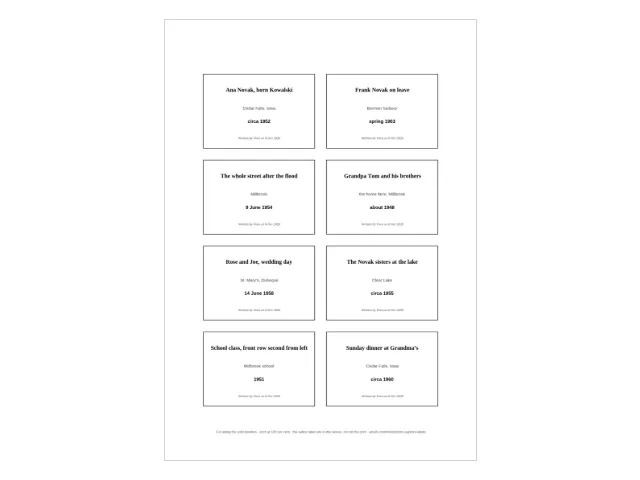
| Who | Full names: first and last, maiden names in brackets | Married names change; “Ana Novak, born Kowalski” survives both |
| Where | Place, as exactly as you know it | A town beats a country; a house or a street beats a town |
| When | An honest date: a year, a season, a whole day, “circa 1952” | A marked guess beats a confident blank |
| Written by | Your name and the date you wrote it | The next generation knows whose word it is |
The maiden names are the part that gets lost first. Aunt Ana was “Kowalski” in 1952 and “Novak” by 1958, and the family tree needs both. The “written by” line matters more than it looks: it is the difference between a name someone in the family vouches for and a guess that hardened into fact somewhere along the way.
The caption card maker above types all four onto a printable card, one photo per line as who | where | when, and prints your “written by” line small on every card, so the record carries its own provenance. If you would rather handwrite, the blank write-in cards give you ruled lines with WHO, WHERE, WHEN and NOTES already marked.
Which pencil works on which kind of print?
The ten-second test: turn the print over and touch the back. Paper-feel? It is fiber-based, the older kind, through roughly the 1960s. Waxy or plastic-feel? It is resin-coated, the standard drugstore and studio print from around the 1980s onward (Kodak introduced resin coating to color prints in 1968, and the process took over the photo labs through the 1970s; Archival Methods, “Tips for Labeling Photos and Snapshots”, published 2024, updated 11 March 2026, checked 6 October 2026).
| Your print | The back feels | Pencil to use | Why |
|---|---|---|---|
| Fiber-based, older | like paper | #2 or HB, the everyday pencil | takes graphite cleanly; hard enough for small handwriting; erases |
| Resin-coated, 1970s on | waxy, plasticky | soft 4B or 6B graphite | the plastic coating sheds a #2 without a mark; the softer graphite bites |
| Any print, if unsure | either one | the card or sleeve | no wrong answer exists |
That second row is the correction this page exists to make. The quick answers say “#2 or HB pencil” full stop, and on a resin-coated print a #2 skates off the waxy surface leaving nothing but a shine. The softer-graphite fix traces back to the Image Permanence Institute (the conservation supplier Archival Methods credits them directly for it), and it works because softer graphite is darker and grabs where harder graphite slides.
The never-list, all with the same reason (they damage or cannot be undone): ballpoint pens, felt-tip markers, sticky notes, tapes and stickers of every kind, and label-makers; the pressure alone embosses the print.
How do you label photos in a photo album?
You label the album, not the photo. Write on the page margin, on a paper slip beside the picture, or on the card-stock insert if the album uses pockets. What you never do is peel a print off an old page: the adhesive holds tighter than the emulsion, and a peeled print arrives with the page surface stuck to its face. If the names matter and the album is old, photograph the page as it lies first, the whole spread, then work from that.
Two album rules worth keeping (loc.gov, checked 6 October 2026):
- Avoid the “magnetic” self-adhesive albums with the plastic lifting sheet: the adhesive ages onto the prints, and it is the one album kind the Library names as a trap.
- Loose photos headed for an album or a box do better in paper or stable-plastic sleeves first; sleeves can be labeled with pencil on the outside, which is exactly where the caption cards go.
What does a photo-labeling kit cost?
The honest answer, with prices as listed and read on 6 October 2026:
| The kit | What it costs | Where the number comes from |
|---|---|---|
| Typed caption cards | $0, printed from the maker on this page, on paper you own | computed on your device |
| A #2 (HB) pencil | $0, the one in the kitchen drawer | nothing to buy |
| Soft graphite for waxy prints | $15.20 a two-pack (Cretacolor Monolith 4B with pencil caps, item 99-GP-4B2; the 6B pack is the same price; the seven-pencil HB–9B set is $37.80) | archivalmethods.com/product/graphite-pencils, read 6 October 2026 |
| Archival pigment pen, for cards and envelopes only, never the print | $7.05 as listed (Sakura Pigma Micron, item 99-003; the assorted set $12.35) | archivalmethods.com/product/permanent-marker-pens, read 6 October 2026 |
| Sleeves + insert, the per-photo home | 4 × 6 pocket page $26.75 + white card-stock inserts $3.65, as listed (the pages state no pack sizes) | archivalmethods.com/product/print-and-slide-pages · /product/acid-free-paper-inserts, read 6 October 2026 |
Start at the top row. A pencil and the free cards label an entire box this evening; the sleeves and the soft graphite can follow when the box earns them. Storage itself is free rules: cool (under 75 °F), dry (under 65 % relative humidity), out of the hot attic and the damp basement. That is the National Archives’ whole storage guidance in one sentence (archives.gov, How to Preserve Family Archives, checked 6 October 2026).
How do you label photos for someone with memory loss?
Big, and where they can see it. Caregivers describe the same discovery over and over: labeled photographs bring a parent with dementia back to the names, sometimes a little independence, sometimes just a good hour with the album. What fails at this job is small handwriting on a photo back.
The card maker’s large-print style exists for exactly this: 90 × 60 mm cards, six to a sheet, with the who, where and when in type big enough to read across the table. Families use them in memory boxes, on a photo ring, next to the armchair where the album lives. The same cards do quiet duty as place labels at a family gathering, where the name under the photo does the introductions.
One honesty rule: say “circa” when the year is a guess. A parent repeating a wrong date as gospel is worse than a parent repeating an honest “around 1952, we think”.
What about the digital copies?
The scans deserve labels too, and theirs are easier: name the file and caption the photo. The convention the digital-archiving world keeps repeating is a good one, YYYY-MM-DD_Lastname_Description (1944-06_circa_novak-frank_brest-harbour.jpg works fine with what you know; the shape matters more than the completeness), and a 300 DPI scan is the working standard for prints you may want to reprint. Label the digital copy with the same four fields and the same honesty, and both copies carry the names.
The rest of this site’s old-photo bench picks up where the labels end: the slides guide shows how to read and copy a mount label before it is cropped away, the negatives guide brings the orange strips back to pictures, and the restoring old photos page walks the whole repair bench (scratch remover, faded color restorer), plus the print size checker for the reprint once the print is labeled and scanned. The Photos shelf holds them all.
A box gets labeled once, in one evening, with paper and pencil, and the names stop leaking. Start with the pictures someone would ask about first: the weddings, the uniform, the baby. Print a sheet of cards, write what you truly know, and let the box answer questions for another fifty years.
Questions
What is the best thing to write on the back of old photos with?
A pencil: a #2 or HB on the older fiber-based prints, a soft 4B or 6B graphite on the waxy resin-coated prints from roughly the 1970s onward. Write lightly, along one edge of the back, with the photo flat on a firm surface. If the pencil will not mark the back at all, that is the waxy kind, and the label belongs on a card or sleeve instead.
Is pencil really safe on photographs?
Graphite is the marking material the archives themselves fall back on: the Library of Congress says if you must mark a photo, write on the back near the edge with a soft graphite pencil, and preferably mark the sleeve instead. Pencil does not bleed, does not fade in normal storage and can be erased, which is more than can be said for any ink.
Why is a ballpoint pen bad on the back of a photo?
Two reasons. The ball presses hard enough to emboss the paper: the groove and the mirrored ridge show through to the front of thin prints. And ballpoint ink carries solvents that can slowly migrate and stain paper and emulsions over the years. The writing survives; sometimes the photo under it does not.
What if I don't know who is in the photo?
Write what is true. 'Two soldiers, probably France, circa 1944, written by Vera 12 Oct 2026' is a record; a confident wrong name is a trap for whoever comes next. Ask the oldest person in the family while you can, say 'circa' when the year is a guess, and prefer 'unknown' over a guess.
How do I label photos without writing on them at all?
Put the label on the enclosure: a card or slip in the sleeve or envelope, a note on the album page, a line on the card-stock insert behind a print. This is what the Library of Congress prefers, what conservation suppliers design for, and what the free caption card maker on this page prints.
How much does it cost to start labeling a box of photos?
Nothing: the cards print free on this page, and a #2 pencil comes out of a kitchen drawer. The soft 4B/6B graphite for waxy prints runs $15.20 for a two-pack and an archival pigment pen is $7.05, both as listed on the conservation supplier's pages on 6 October 2026, and the pen is optional, because the cards take pencil perfectly well.